Common fault
Why is there water under my refrigerator?
Short answer
Water under a built-in comes from one of two places, and both are inexpensive repairs that get expensive by being left.
Why we start there
Clean, cold water pooling at the front is the supply side: the line running to the ice maker or the dispenser has let go, almost always at a compression fitting. Water that appears with ice on the freezer floor means the defrost drain has iced closed, so the melt water backs up inside the cabinet and finds its way out under the door. In La Jolla the reason to move fast is rarely the appliance. It is the floor.
What happens next
The flooring is the whole argument for calling on the day rather than the weekend. Kitchens in this town are finished in materials that do not forgive standing water: wide-plank hardwood, engineered wood over a slab, natural stone with grout that wicks, and in the older Village and Lower Hermosa houses, original wood floors that were never intended to be under a refrigerator at all. The repair to a split supply line or an iced drain is small and predictable. The repair to a hardwood floor that has been quietly absorbing water underneath a heavy built-in for a week is neither, and it is not something a plumber or a floor contractor can undo cheaply once the boards have cupped.
There is a second thing that happens specifically in a coastal, humid kitchen, and it gets mistaken for a leak. On gray, saturated mornings, a door gasket that has lost its magnetic pull lets moist air run continuously into the cabinet. That moisture condenses on cold surfaces and shows up as water in the bottom of the compartment, sweating on the interior walls, and eventually a small puddle in front of the unit. Nothing has split and no line is leaking. The gasket is the fault, and on units with heavy custom panels it is often the panel weight that pulled the door out of square in the first place. We check the seal with a measurement before we start chasing plumbing.
If that matches what yours is doing, say so when you call — it decides which parts come on the van.
Reviews
We are only in the house a few months of the year. Came back to the wine column reading its setpoint while the top zone sat well above it, and the ice bridged into one lump in the bin. Rang late at night and got a person. He dealt with both in one visit.
- ★★★★★
Water was tracking out from under the built-in onto original wood floors and I assumed a line had split. It was the defrost drain iced closed. He cleared it, dried underneath and had a proper look at the boards before he left so I knew where I stood. Came out that day.
- ★★★★★
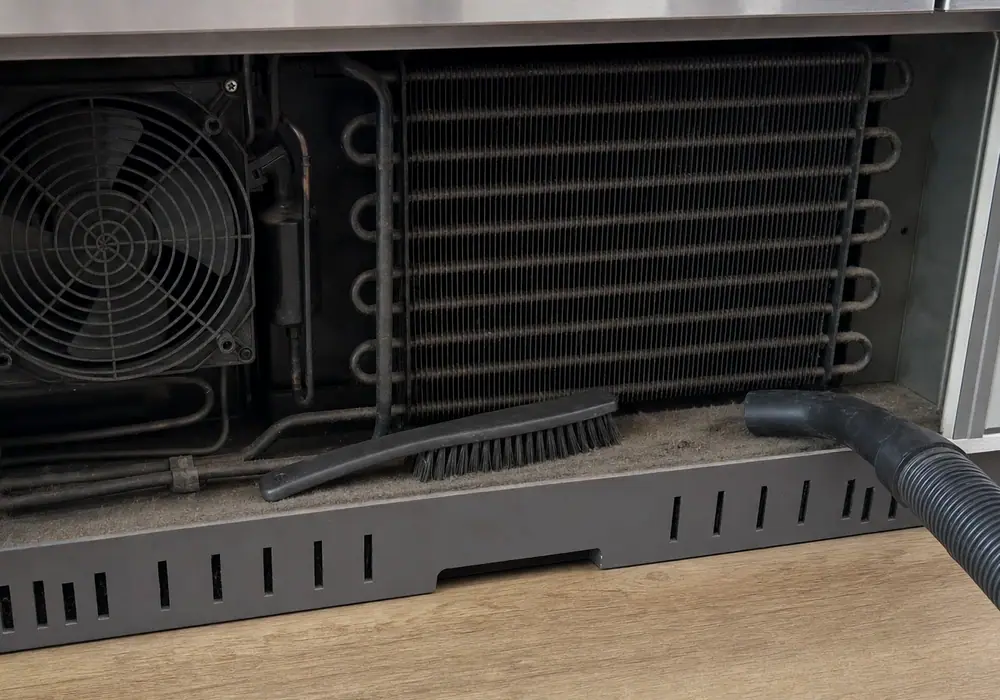
A whir behind the bottom grille that was not there last year, and up on our side of the hill it got louder through the afternoon when the kitchen heats up. Condenser fan bearing on the way out, so he changed the motor before it seized. Glad I called about a noise.
Appliance down in La Jolla?
Tell us the brand and what it is doing — we can usually name the likely repair before we arrive.
Questions
Frequently asked questions
Is a twenty-year-old Sub-Zero worth repairing, or should I replace it?
Repair, nearly always. These cabinets were built to be opened and serviced, and age brings ordinary parts: evaporator fan, defrost heater, thermistor, door gasket, ice maker module, condenser fan motor. Replacement is the expensive path — a built-in is cabinetry as much as appliance, and in most La Jolla kitchens the surround has to come apart to get the old one out.