Guide
Wine cabinets: zones, humidity, and what two degrees actually costs
A wine cabinet reading the number you set while the bottles feel warm to the hand is not lying so much as answering a different question. The sensor reports air at one point in the cabinet; the wine is glass and liquid on a rack somewhere else, and the two are allowed to differ by more than most owners expect. On wine that gap matters, because a two-degree drift is a fault rather than a tolerance — and the real cost is not the two degrees of average, it is the swing hiding underneath them.
What a zone actually is
A single-zone cabinet holds one temperature throughout and is the simpler machine. A dual-zone cabinet is asked to hold two, usually a cooler zone for whites and sparkling and a warmer one for reds, and how it does that explains every dual-zone fault. Depending on the design, the second zone is served either by its own evaporator and fan, or by a metered share of the cold air the single evaporator produces, controlled by a damper. In both layouts the refrigeration itself — compressor, condenser, refrigerant charge — is common to the whole cabinet. That is why one zone holding while the other drifts is genuinely good news rather than bad: the working zone is a live demonstration that the expensive half of the machine is fine, and the fault is confined to whatever serves the failing zone. Both zones drifting together is the different conversation, and that one starts outside the cabinet at the condenser rather than inside it.
- One zone holding, one drifting — that zone's fan, damper, evaporator or its sensor
- Both zones drifting together — condenser, condenser fan, ventilation clearance, or the sealed system
- Both zones cold with the compressor never resting — usually airflow, or a door that stopped sealing
- A zone that hunts up and down without settling is not repaired, whatever its average reads
Why the panel and the bottles disagree, and how to settle it
Two things pull the reading and the reality apart. The first is sensor placement: the control measures air at a fixed point chosen so the machine can regulate itself, and that point is not the middle of a loaded rack. The second is thermal mass. Air changes temperature in seconds and a full bottle takes hours, so cabinet air can swing several degrees through a cycle while the wine sits placidly at the average — and equally the wine can be sitting warm while a well-placed sensor reports a number that looks perfectly correct. Settling it costs nothing. Fill a spare bottle with water, drop a thermometer probe into the neck, stand it on the rack in the middle of the cabinet and leave it overnight, then do the same in the second zone. Water is close enough to wine thermally that what it reads is what your collection is living at. Agreement within a degree or two means the cabinet is doing its job and the complaint lies elsewhere. Disagreement is a real fault, measured at the only place that counts.
Humidity: where it comes from and what it is for
Most wine storage does not humidify. It maintains humidity by not removing it, which is a different mechanism and explains why humidity complaints trace back to unexpected places. A refrigerator runs a very cold evaporator, air passes across it, moisture condenses onto that cold surface and drains away, and the compartment ends up dry — which is why an old refrigerator is the worst place to keep wine for years. A wine cabinet runs a much smaller difference between its evaporator and the cabinet, so far less moisture is pulled out of the air and the space settles at a higher relative humidity on its own. Roughly half to two-thirds is the range generally aimed for. Fall much below half and a cork slowly loses moisture from its exposed end, shrinks fractionally and stops being an airtight seal. Sit far above two-thirds and the wine itself is untouched, but labels lift and adhesive fails, and on a collection where the label carries value that is a real loss.
- Humidity that has fallen usually means a door that stopped sealing, a defrost pattern running long, or a cabinet working far harder than its design point
- Humidity that has risen usually means a door left ajar repeatedly, or a room that is itself saturated
- An evaporator that has begun frosting is drying the cabinet out as a side effect
- Fog on the inside of the glass is a dew point and door problem, not evidence that the cabinet is running too cold
What two degrees costs
Two degrees of average temperature is the part people worry about and the smaller of the two effects. Chemical reactions run faster when it is warmer, and at cellar temperatures the working rule is that development roughly doubles in rate for every fifteen or so degrees Fahrenheit — so two degrees buys perhaps a tenth faster aging, real across decades and invisible across a summer. The expensive number is the swing a drifting zone usually hides. A cabinet cycling four or five degrees every day puts its contents through a physical process rather than a chemical one — the liquid expands as it warms, contracts as it cools, and has to push against something. In a sound bottle that something is the small volume of gas under the cork, and nothing happens. In a bottle whose cork has dried, or whose capsule already shows a sticky line of seepage, wine is pushed past the seal on the way up and air is drawn back on the way down, which is oxidation arriving on a daily schedule. So the answer worth asking a technician for is not the setpoint reached but whether both zones settle and stay settled across several complete cycles.
Cheap faults, expensive faults, and which is likely
Most wine cabinet calls end cheaply, and the least glamorous item on the list is the most common. A condenser matted with dust and hair cannot reject heat, so the cabinet runs longer and longer duty cycles and eventually loses the zone with the least margin to give, which on most units is the upper one. After that come the door and its seal, a circulation fan for one zone, a damper that has stopped modulating, and a thermistor that has drifted and taken the panel reading with it. The genuinely expensive fault is a sealed-system problem — a refrigerant leak or a failed compressor — and it is the least common thing on this list rather than the first thing to fear. Its signature is distinctive: both zones fail together, neither will pull down at all, and the cabinet either runs continuously without ever getting cold or does not run at all. One zone sitting three degrees warmer than it was asked for is not that.
- Condenser loaded with dust — a cleaning, and often the entire repair
- Door seal or hinge alignment on a heavy glass door — an adjustment or a gasket
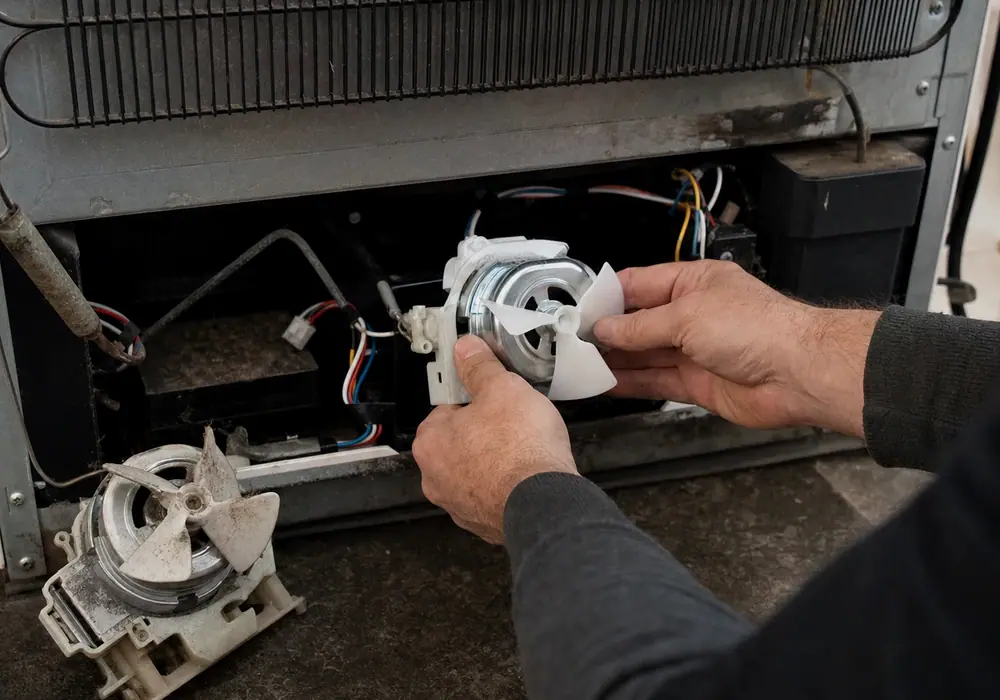
- A zone circulation fan — an ordinary part and normally one visit
- Anti-condensation heater circuit where fitted — a fog complaint, not a cooling one
- Thermistor drift — an inexpensive part, and the reason the panel was reporting fiction
- Sealed system, meaning a leak or the compressor — uncommon, and the only genuinely expensive answer
How the cabinet is loaded changes what it can hold
Two habits produce complaints that no part will fix. The first is packing. Solid shelving and bottles pressed edge to edge block the circulation the cabinet was designed around, and a unit stuffed to the roof develops a genuine vertical gradient between its top and its bottom rack — measure it with the water bottle at both heights and you will find it. The second is standing bottles upright for long periods. A cork only stays sealed while the wine keeps its inner face wet, so upright storage exposes it to whatever the cabinet humidity happens to be, and in a cabinet already running dry that is the fastest way to lose a bottle. Neither habit is a fault in the machine. Both are worth ruling out before anyone opens it up.
- Leave the circulation path at the back of the racks clear rather than packing to the wall
- Measure top and bottom rack separately before deciding a zone has failed
- Store bottles on their side unless they are being drunk within weeks
Questions
Frequently asked questions
What temperature should I actually set?
For a single zone holding a mixed collection, the mid fifties Fahrenheit is the long-standing compromise. On a dual-zone cabinet the cooler zone runs in the mid to high forties for whites and sparkling, the warmer one in the mid to low sixties for reds. Stability matters more than the number: two degrees warm but rock steady outlasts a perfect average that swings daily.
My cabinet never shows a humidity reading. Should I add a tray of water?
No. Most wine storage has no humidity display because it has no humidity control, and standing water in a cabinet not designed for it invites mold on the racks and labels. If corks are drying, look elsewhere: a door that stopped sealing, an evaporator frosting and drying the air as a side effect, or a cabinet running long cycles because it cannot shed its heat.
One zone reads three degrees off the other. Is that within tolerance?
The zones are supposed to differ; what matters is whether each one holds the temperature it was asked for. A zone three degrees away from its own setpoint is a fault, not a tolerance. Measure with a thermometer in a water-filled bottle at rack level before deciding — a wrongly placed sensor and a genuinely drifting zone read the same on the panel.
If it is already broken
Appliance down in La Jolla?
Tell us the brand and what it is doing — we can usually name the likely repair before we arrive.