Guide
Why a built-in is a different job from a freestanding refrigerator
The difference is not size, and it is not price. A built-in is serviced in place rather than pulled into the room, it rejects its heat forward through a grille instead of backward into the kitchen, and on a Sub-Zero it runs two entirely separate sealed systems rather than one. Those three facts change the diagnosis, the tools, the parts list and the arithmetic of whether to repair at all — which is how a competent technician who works on freestanding refrigerators every day can arrive at a built-in and reach the wrong conclusion honestly.
It is not meant to come out of the wall
A freestanding refrigerator is a box on rollers. Service on one usually begins by walking it out into the room, and every design decision behind it assumes that will happen: the condenser lives at the back or underneath, the compressor sits in an open compartment behind a cardboard cover, and the whole machine is meant to be approached from three sides. A built-in assumes the opposite. It is anchored to the cabinetry or the wall, the surround is finished tight to it, a stone counter often overhangs the top by a fraction of an inch, flooring is frequently laid up to it and sometimes around it, the water line is plumbed in behind, and a custom panel may be screwed to the door. Everything on it that routinely needs service is reachable from the front for exactly that reason. The condenser and its fan sit behind the lower grille. The evaporator and its fan sit behind a rear panel inside the compartment. The control is behind the top grille or the front panel. Pulling a loaded built-in out across a wood or stone floor is not thoroughness — it is the most common way a service call leaves damage that costs more than the fault did.
One sealed system against two
This is the difference that changes the actual diagnosis rather than the logistics. A conventional freestanding refrigerator has one compressor and one evaporator, and that evaporator lives in the freezer. A fan blows some of that cold air through a damper into the fresh-food compartment, which is why the two compartments on a freestanding unit share air and why a freestanding fresh-food section runs dry. A Sub-Zero built-in with dual refrigeration has no such path. Two compressors, two evaporators, two sealed systems, and no air passing between the compartments at all. The same symptom therefore means opposite things on the two machines. A warm fresh-food section over a cold freezer on a freestanding refrigerator points straight at the damper or the air path between them. On a built-in there is no damper between them to blame, and that symptom instead eliminates the freezer system entirely and confines the fault to the refrigerator circuit — its own evaporator fan, its own defrost heater or thermistor, its own iced coil. A technician carrying freestanding habits into that kitchen spends the first half hour looking for a component that was never installed.
- Freestanding: one compressor, one evaporator, air shared through a damper
- Sub-Zero built-in: two compressors, two evaporators, no air exchanged between compartments
- Warm fridge over a cold freezer means the damper or air path on one, and the refrigerator circuit on the other
- The built-in keeps its fresh-food side more humid because it is not being fed dry freezer air
The heat leaves through the front
A freestanding refrigerator dumps its heat off a coil at the back or underneath, straight into the room, and if that coil gets dusty the usual remedy is to pull the unit out once a year and vacuum it. A built-in cannot do that, because there is no room behind it and nothing above it but cabinetry. Instead the condenser sits behind the toe grille at the bottom and a fan pulls room air through the fin pack and pushes it back out at the front. Every watt of heat the appliance produces leaves through that one opening. The consequences follow directly. A grille blocked by a decorative toe kick fitted during a remodel, a filler panel that left under an inch of clearance, a matted fin pack, or a condenser fan with a worn bearing all produce the same behavior: the unit copes in a cool room and starts drifting warm on warm afternoons, then recovers overnight. Owners describe that as the appliance being fine most of the time, which is the single most diagnostic sentence in this trade. The check needs no tools at all: take the grille off and see whether a flashlight held behind the fins shows light through them.
The door is a piece of furniture
A freestanding door is sheet steel and foam and it weighs what it weighs. A built-in door frequently carries a custom panel matched to the cabinetry, and on a full-height column that panel can be a substantial piece of hardwood hung a long way out from the hinge. The hinges and cams are built for it, but two decades of that leverage moves things, and the movement is measured in fractions of an inch rather than anything you would see standing in the kitchen. The door drops slightly, the seal holds along the top and opens at the bottom corner, and room air runs into the cabinet continuously. What gets reported is never a door problem. It is frost returning on the rear wall a week after it was cleared, moisture in the bottom of the compartment, or a refrigerator that will not quite hold temperature — symptoms that read as defrost faults, get repaired as defrost faults, and come back in six weeks. On a freestanding refrigerator this failure mode barely exists, because there is no panel and no leverage. On a built-in it is routine, and door alignment belongs early in the diagnosis rather than after the parts have been fitted.
The freestanding habits that produce wrong answers
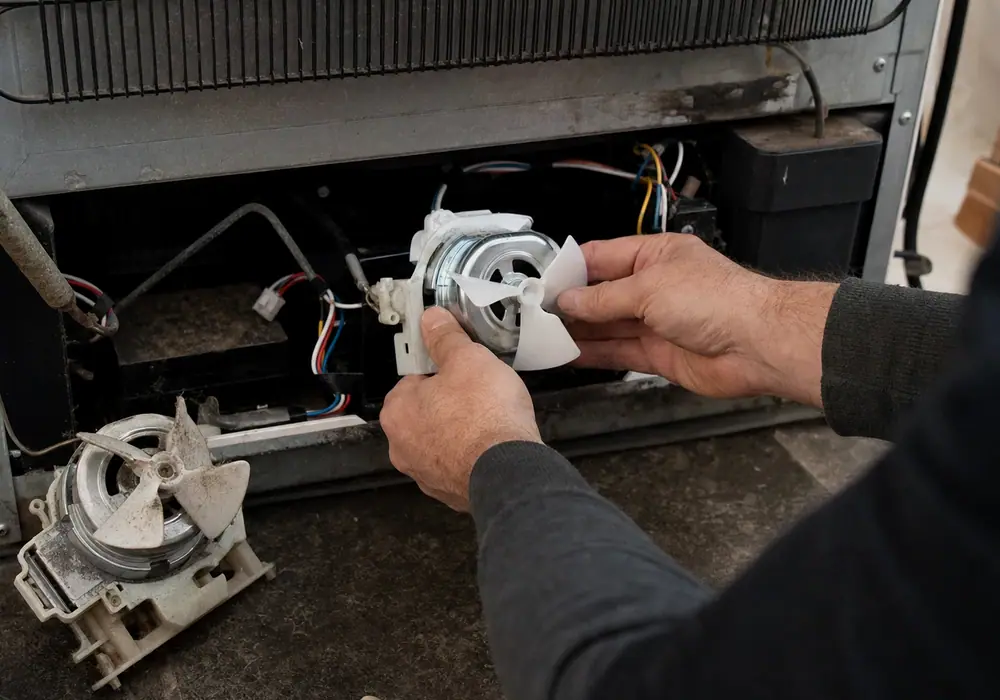
None of what follows is a criticism of technicians who work mostly on freestanding refrigerators; it is a description of assumptions that are correct on one machine and wrong on the other. Hunting for a damper between the compartments on a dual-refrigeration cabinet is the classic one, because on the machine most technicians see all day that damper exists and is a common failure. Condemning the compressor because the fresh-food section is warm is the expensive one, when a hard-frozen freezer alongside it has already proved a sealed system is working. Pulling the cabinet out to get at the back is the one that damages floors. Replacing the control board because the display disagrees with a thermometer, when a drifted sensor produces exactly that symptom for a fraction of the cost, is the one that gets repeated. And fitting a universal evaporator fan because it bolts to the bracket is the one that brings everybody back in a season.
- Looking for a damper between compartments that dual refrigeration does not have
- Blaming the compressor for a warm fresh-food section while the freezer is hard frozen
- Withdrawing the cabinet across a finished floor to reach a condenser that is at the front
- Replacing the board when a drifted thermistor explains the disagreement more cheaply
- Fitting a pattern fan or gasket because it physically fits the bracket or the channel
Questions
Frequently asked questions
Is a built-in just a more expensive refrigerator?
Different machine, different service model. It is fixed to the cabinetry rather than standing free, vents its heat forward through a toe grille rather than backward into the room, puts every serviceable component within reach from the front, and in the Sub-Zero case runs two independent sealed systems instead of one. Each of those changes what a fault means and how it is found.
Does a built-in ever have to be pulled out for service?
Rarely. The condenser, condenser fan, evaporators, evaporator fans, defrost components, sensors and controls are all reachable in place, the whole point of the layout. Some sealed-system work and full condenser replacements do call for the cabinet to be withdrawn; when that is genuinely necessary it comes out unloaded, doors off if they need to be, with hard protection down over the flooring first.
My built-in refrigerator is warm and the freezer is still frozen. Is that the compressor?
Almost certainly not — on a dual-refrigeration cabinet the frozen freezer is what tells you so. The two compartments have separate compressors and separate evaporators, so a hard freezer proves one sealed system is running properly and leaves the fault on the refrigerator side: its evaporator fan, its defrost heater or thermistor, or an evaporator iced over solid. Ordinary parts, usually a single visit.
If it is already broken
Appliance down in La Jolla?
Tell us the brand and what it is doing — we can usually name the likely repair before we arrive.